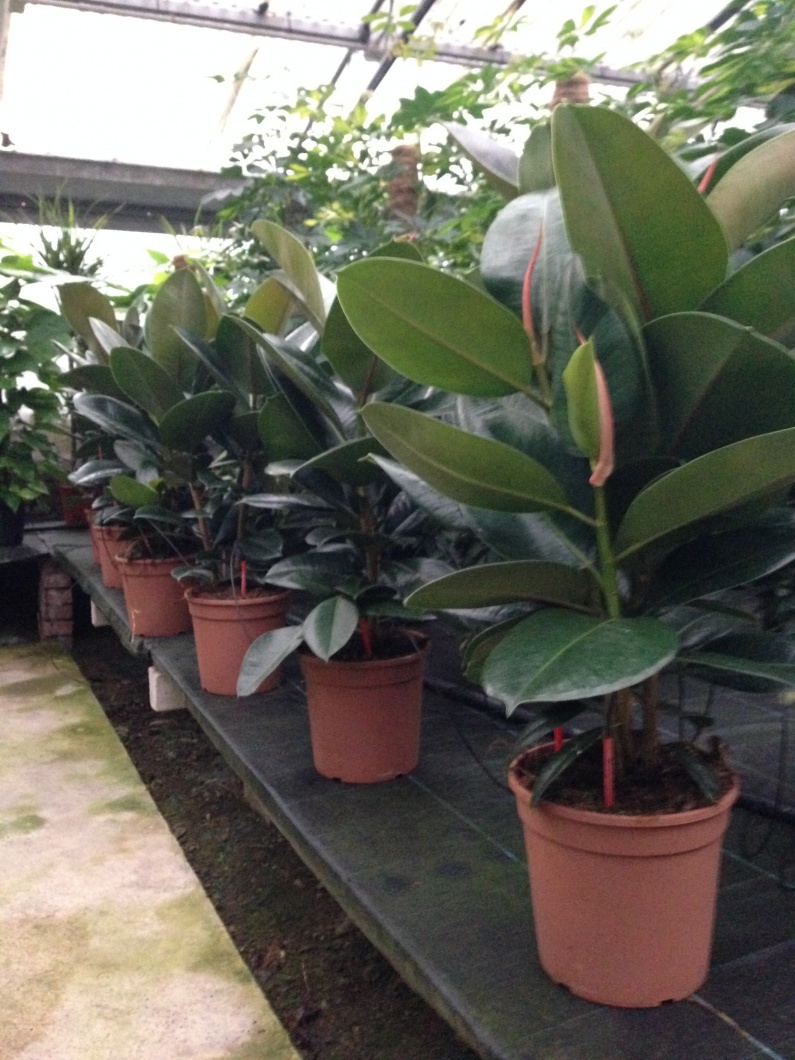
Ficus Robusta with branches is available in different sizes from 21 cm jar height, and plant cm 60 high, until specimens up to cm 170-180.
The Ficus Robusta is a houseplant that belongs to the Moracee family. Within the genus “Ficus” we can find a really large number of species, the majority of which are not particularly popular on the market because of the shape of leaves that do not represent the ideal for an ornamental plant.
The Ficus Elastic Robusta is often called as the rubber tree or blanket. In the first stage of development the plant’s leaves of Ficus Robusta are characterized by a red coloured sheath containing them, which will be then removed. The plant belongs to the gender of perennials: it is a plant that does not bloom, it’s typical of Asia, because it comes especially from India. It’s known to be particularly widespread in the market for its important qualities from an aesthetic and ornamental point of view, but it is much appreciated also due to the easy growth rules.
Care
It prefers all quite bright areas, even if it does not like direct sunlight and is well suited indoor even in situations of low lights.
As for the substrate please use soils for green plants, always considering the necessary addition of a limited amount of expanded clay to better facilitate drainage. Watering steadily the plants especially during the summer season. However, when the temperature begins to drop, the advice is to decrease the frequency of irrigation, making sure to keep the soil slightly moist. During the summer season it is important to pay close attention to fertilization: it is necessary to fertilize this plant every ten days with a specific product for green plants.
Propagation
The propagation of the Ficus Robusta plant is performed by the cutting system during the spring season. As for repotting, it is a task that must be done every two years in late spring season. It’s important to highlight that the new vessel used, should have a width not too much higher against the previously used one.
Remind that the ficus should not be pruned, but you need to remove only the dried or damaged leaves. As for the operation of grooming, you must use a soft cloth to remove the dust laid on the largest leaves. During summer, this plant can also be placed on balconies and terraces, being careful not to be affected from direct sunlight.
Diseases and adversity
Recall as this plant is known to be particularly susceptible to attacks by insects and parasites, which, however, can be fight with the appropriate drugs. Do not forget however that the plant has also an excellent resistance against all those infestations. When this plant has to do with a particularly high level of moisture, can be attacked also by the gray mold.